Lesson 01: Modal Verbs

Lesson 87/137 | Study Time: 30 Min
Course: English XI
Lesson 01: Modal Verbs

Introduction:


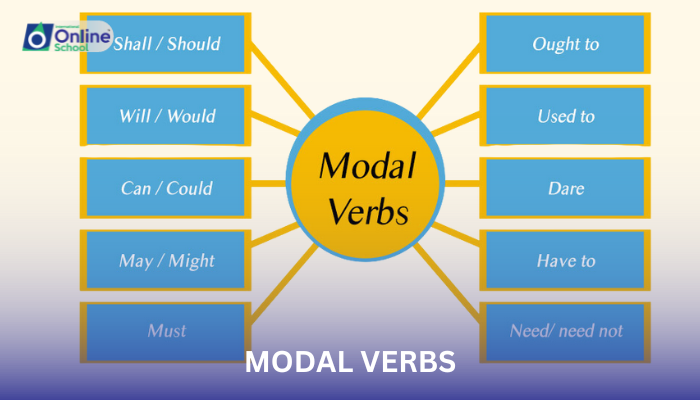
Modal verbs are a special kind of verbs that are used to express possibility, ability, necessity, permission, and obligation. They are different from regular verbs because they don't have a past or future form, and they are always followed by a base form of the main verb.


i. Can:


Use: Expresses ability or permission.


Examples:


  •  I can swim.


  • Can I go to the bathroom?


ii. Could:


Use: Indicates past ability, polite requests, or suggestions.


Examples:


  • When I was younger, I could climb trees.


  • Could you please pass the salt?


iii. Will:


Use: Shows future possibility or willingness.


Examples:


  •  She will help you with your homework.


  •  I think it will rain tomorrow.


iv. Would:


Use: Used for polite requests, hypothetical situations, or expressing preference.


Examples:


  •  Would you like some more cake?


  •  If I were rich, I would travel the world.


v. Shall:


Use: Often used in formal language to indicate a suggestion or offer.


Examples:


  •  Shall we go to the park?


  •  I shall submit my report by tomorrow.


vi. Should:


Use: Expresses advice or obligation.


Examples:


  • You should eat more vegetables.


  • Students should complete their homework on time.


vii. Must:


Use: Indicates necessity or a strong obligation.


Examples:


  •   I must finish my project by Friday.


  •  You must wear a helmet while riding a bike.


viii. Might:


Use: Expresses a possibility or a suggestion in a less certain manner.


Examples:


  •  It might rain later, so take an umbrella.


  • She might join us for dinner.


ix. May:


Use: Signifies permission or a possibility.


Examples:


  • You may leave the classroom now.


  •  It may snow in the evening.


x. Ought to:


Use: Similar to "should," indicating duty or moral obligation.


Examples:


  •  You ought to apologize for your mistake.


  • We ought to respect our elders.


Understanding and using modal verbs correctly is essential for effective communication. Whether expressing ability, making polite requests, giving advice, or indicating necessity, these verbs play a crucial role in shaping the meaning of our sentences. Practice using them in various contexts to become a confident communicator!


Ayesha Khan

Ayesha Khan

Product Designer
Profile

Class Sessions

1- Lesson 01: Responsibilities of Youth Comprehension (A) 2- Lesson 02: Responsibilities of Youth Comprehension (B) 3- Lesson 03: His First Flight Comprehension (A) 4- Lesson 04: His First Flight Comprehension (B) 5- Lesson 05: From Mother With Love Comprehension (A) 6- Lesson 06: From Mother With Love Comprehension (B) 7- Lesson 07: It's Country for Me Comprehension (A) 8- Lesson 08: It's Country for Me Comprehension (B) 9- Lesson 09: Choice of Career Comprehension (A) 10- Lesson 10: Choice of Career Comprehension (B) 11- Lesson 11: Wasteland Comprehension (A) 12- Lesson 12: Wasteland Comprehension (B) 13- Lesson 13: The White Lamb Comprehension (A) 14- Lesson 14: The White Lamb Comprehension (B) 15- Lesson 15: The Importance of Family Comprehension (A) 16- Lesson 16: The Importance of Family Comprehension (B) 17- Lesson 17: The Blanket Comprehension (A) 18- Lesson 18: The Blanket Comprehension (B) 19- Lesson 19: A Long Walk Home Comprehension (A) 20- Lesson 20: A Long Walk Home Comprehension (B) 21- Lesson 21: University Days Comprehension (A) 22- Lesson 22: University Days Comprehension (B) 23- Lesson 23: School VS Education Comprehension (A) 24- Lesson 24: School VS Education Comprehension (B) 25- Lesson 25: What You Do Is What You Are Comprehension (A) 26- Lesson 26: What You Do Is What You Are Comprehension (B) 27- Lesson 27: Drug Abuse in Youth of Pakistan Comprehension (A) 28- Lesson 28: Drug Abuse in Youth of Pakistan Comprehension (B) 29- Lesson 29: How to Take a Job Interview Comprehension (A) 30- Lesson 30: How to Take a Job Interview Comprehension (B) 31- Lesson 01: Good Timber Comprehension (A) 32- Lesson 02: Good Timber Comprehension (B) 33- Lesson 03: Mother To Son Comprehension (A) 34- Lesson 04: Mother To Son Comprehension (B) 35- Lesson 05: The World is Too Much With Us Comprehension (A) 36- Lesson 06: The World is Too Much With Us Comprehension (B) 37- Lesson 07: Ozymandias Comprehension (A) 38- Lesson 08: Ozymandias Comprehension (B) 39- Lesson 09: A Dream Within a Dream Comprehension (A) 40- Lesson 10: A Dream Within a Dream Comprehension (B) 41- Lesson 11: The Road Not Taken Comprehension (A) 42- Lesson 12: The Road Not Taken Comprehension (B) 43- Lesson 01: Application for Software Engineer (Tech Company) 44- Lesson 02: Application for Marketing Coordinator (E-commerce) 45- Lesson 03: Application for Financial Analyst (Finance Firm) 46- Lesson 04: Application for Registered Nurse (Hospital) 47- Lesson 05: Application for Graphic Designer (Creative Agency) 48- Lesson 06: Application for Customer Service Representative (Telecommunications) 49- Lesson 07: Application for Project Manager (Construction) 50- Lesson 08: Application for Human Resources Generalist (Technology Start-up) 51- Lesson 09: Application for Sales Associate (Retail) 52- Lesson 10: Application for Content Writer (Digital Marketing Agency) 53- Lesson 01: Cover Letter for Customer Service Representative 54- Lesson 02: Cover Letter for Marketing Coordinator 55- Lesson 03: Cover Letter for Software Developer 56- Lesson 04: Cover Letter for a Summer Internship in a Professional Setting 57- Lesson 05: Cover Letter for Financial Analyst 58- Lesson 06: Cover Letter for Project Manager 59- Lesson 07: Cover Letter for Graphic Designer 60- Lesson 08: Cover Letter for Human Resources Specialist 61- Lesson 09: Cover Letter for Content Writer 62- Lesson 10: Cover Letter for Registered Nurse 63- Lesson 01: Sample Resume of Financial Analyst 64- Lesson 02: Sample Resume of Software Developer 65- Lesson 03: Sample Resume for Marketing Coordinator 66- Lesson 04: Sample Resume of Customer Service Representative 67- Lesson 05: Sample Resume of Financial Analyst 68- Lesson 01: Phrasal Verb Exercise 01 69- Lesson 02: Phrasal Verb Exercise 02 70- Lesson 03: Phrasal Verb Exercise 03 71- Lesson 04: Phrasal Verb Exercise 04 72- Lesson 05: Phrasal Verb Exercise 05 73- Lesson 06: Phrasal Verb Exercise 06 74- Lesson 07: Phrasal Verb Exercise 07 75- Lesson 08: Phrasal Verb Exercise 08 76- Lesson 09: Phrasal Verb Exercise 09 77- Lesson 10: Phrasal Verb Exercise 10 78- Lesson 01: Letter to a Pen Pal 79- Lesson 02: Letter to a Future Self 80- Lesson 03: Letter to a Historical Figure 81- Lesson 04: Letter to a Fictionl Character 82- Lesson 05: Letter to a Friend Goind Abroad 83- Lesson 06: Letter to the Editor 84- Lesson 07: Letter to a Younger Sibling 85- Lesson 08: Letter to a Favourite Teacher 86- Lesson 09: Sample Letter to a Classmate 87- Lesson 01: Modal Verbs 88- Lesson 02: Regular and Irregular Verbs 89- Lesson 03: Transitive and Intransitive verbs. 90- Lesson 04: Present and Past Participles 91- Lesson 05: Infinitives and Infinitive Phrases 92- Lesson 06: Gerunds and Gerund Phrases 93- Lesson 07: Tenses 94- Lesson 08: Present and Past Perfect Continuous Tenses 95- Lesson 01: Illustrate Use and Functions of All Modal Verbs 96- Lesson 02: Illustrate Use of Regular and Irregular Verbs in Speech and Writing 97- Lesson 03: Illustrate Use of Transitive and Intransitive Verbs 98- Lesson 04: Make and Use Present and Past Participles 99- Lesson 05: Illustrate Use of Infinitives and Infinitive Phrases 100- Lesson 06: Illustrate Use of Gerunds and Gerund Phrases 101- Lesson 07: Illustrate Use of Tenses Learnt Earlier 102- Lesson 08: Identify, Change the Form of, and Use Present and Past Perfect Continuous Tenses 103- Lesson 10: Letter to Your Favourite Author 104- Lesson 01: Passage 01 (The Digital Divide) 105- Lesson 02: Passage 02 (Food Insecurity) 106- Lesson 03: Passage 03 (Mental Health Stigma) 107- Lesson 04: Passage 04 (Environmental Degradation) 108- Lesson 05: Passage 05 (Inequality's Echoes) 109- Lesson 06: Passage 06 (The Ageing Population) 110- Lesson 07: Passage 07 (Educational Disparity) 111- Lesson 08: Passage 08 (Digital Privacy and Security) 112- Lesson 09: Passage 09 (The Refugee Crisis) 113- Lesson 10: Passage 10 (Gender Inequality) 114- Lesson 01: Dialogue on Discussing current global challenges (e.g., poverty, climate change) 115- Lesson 02: Dialogue on The role of technology in our daily lives 116- Lesson 03: Dialogue on Pros and cons of social media for teenagers 117- Lesson 04: Dialogue on The qualities of a good friend 118- Lesson 05: Dialogue on Dealing with peer pressure in school 119- Lesson 06: Dialogue on The significance of a balanced diet and exercise 120- Lesson 07: Dialogue on Balancing social life and academics 121- Lesson 08: Dialogue on Discussing future career goals and ambitions 122- Lesson 09: Dialogue on Ways to reduce plastic usage in our daily lives 123- Lesson 10: Dialogue on Climate change and its effects on our planet 124- Lesson 01: Author’s Purpose and Point of View and Their Effects on The Texts 125- Lesson 02: Genres of Literature 126- Lesson 03: Literary Techniques 127- Lesson 04: Deduce meaning of difficult words from context 128- Lesson 05: Contextual Clues 129- Lesson 06: Mastering Active and Passive Voice in Speech and Writing 130- Lesson 07: Conditional Sentences 131- Lesson 08: Gerund and Gerund Phrases 132- Lesson 09: Order of Adjective 133- Lesson 10: Prepositions of Position, Time Movement and Direction 134- Lesson 11: Articles 135- Lesson 12: Nouns 136- Lesson 13: Pronoun 137- Lesson 14: Noun, Noun Phrase and Clause